Your browser version is too low, it may lead to sites not normally access!
You can use the site to function properly, use these browsers.
Your browser version is too low, it may lead to sites not normally access!
You can use the site to function properly, use these browsers.

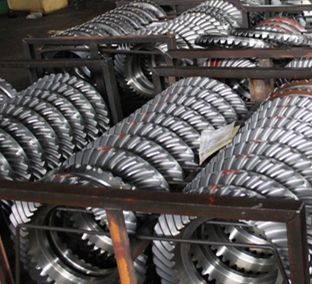
Differential reduction assembly gears are core transmission components in the integrated system of vehicle differential and reducer, mainly undertaking the dual functions of power deceleration and torque increase, and left and right wheel speed compensation. Their operating state directly affects the smoothness of vehicle steering and the passability of complex road conditions. Different from a single transmission gear, differential reduction assembly gears need to be accurately matched with other components in the assembly, and the tooth meshing clearance and installation accuracy must strictly conform to the vehicle's transmission parameters to avoid power transmission deviation or increased local wear.
In terms of working condition adaptation, differential reduction assembly gears need to cope with load changes in multiple scenarios such as vehicle steering, climbing, and bumping. Therefore, a special honing process is adopted for tooth surface treatment to improve the fit and smoothness of meshing, and at the same time optimize the tooth root force structure to reduce fatigue stress caused by frequent variable loads. During the selection process, it is necessary to focus on key parameters such as the modulus and addendum circle diameter of the differential reduction assembly gears to ensure complete matching with the installation size and power output characteristics of the original vehicle assembly, avoiding transmission failures caused by improper adaptation.
In daily operation and maintenance, it is necessary to regularly check the lubrication state of the differential reduction assembly gears, select special gear oil suitable for the assembly's working conditions, and avoid increased tooth surface wear due to oil deterioration; at the same time, pay attention to the transmission noise during vehicle driving. If abnormal noise occurs, it is necessary to promptly investigate the meshing state and tooth surface damage of the differential reduction assembly gears, and repair or replace components in a timely manner to ensure the balanced and stable operation of the vehicle's transmission system.